Bead Colors Explained: Codes vs. Names
If you’ve ever tried to reorder a bead color and found it listed under a different name on another site, you’re not imagining things. This is one of the most common “wait… what?” moments for beaders, especially when you’re trying to keep a stash organized or match a project exactly.
Here’s the simple truth:
Manufacturers standardize the code. Retailers often improvise the name. Once you understand that, shopping across multiple sites gets way easier.
What manufacturers actually standardize: color codes
Major bead makers identify colors and finishes using official numbers/codes in charts and sample cards. These codes are the closest thing to a universal ID.
Miyuki (Delicas + more)
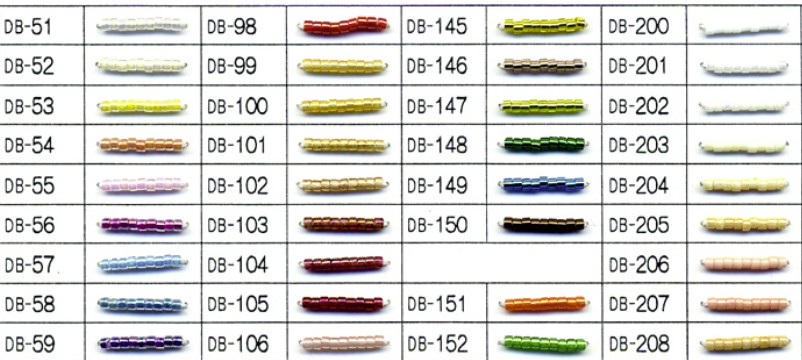
Miyuki Delicas are known for DB color codes (DB### / DB####). You’ll also see descriptive wording in charts (transparent, matte, luster, lined, etc.), but the DB code is what stays consistent across catalogs and ordering.
If the DB code matches, it’s intended to be the same bead, regardless of the product name.
TOHO
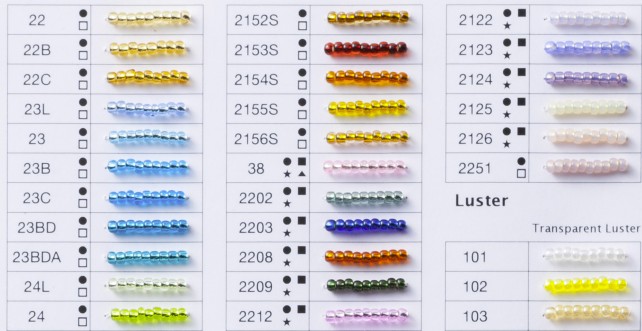
TOHO uses an official code/number system as well. Retailers may describe the color differently, but the TOHO code is the anchor.
Czech / Preciosa Ornela
Czech beads (often from Preciosa/Ornela) typically lean on structured identifiers like:
- article numbers
- color codes
- finish categories
Instead of one universally-used “name,” you’ll usually see an ID system that tells you what it is and how it’s finished.
Bottom line: manufacturers “promise” the code. Names are often secondary.
Why retailer names don’t match
If codes are standardized, why do the names vary so much? Because retailers are trying to be helpful, but they all do it differently.
Common reasons:
- Wording gets shortened or rearranged to fit product titles and read more naturally
- Translation differences (or older chart wording) lead to slightly different phrasing
- Different emphasis: one shop highlights base color (“Grey”), another highlights finish (“Gold Luster”), another highlights effect (“Iris/Rainbow”)
- Search-friendly naming: stores use words people actually type (“Gunmetal,” “Champagne,” “Seafoam”) rather than technical catalog phrasing
- Catalog cleanup over time: names drift, listings get rewritten, but the manufacturer code usually stays stable
Rule of thumb: If the manufacturer code matches, it’s meant to be the same color, even if the wording looks different.
The shopping cheat code that prevents mistakes
When comparing beads across sites, match these first:
- Brand (Miyuki vs TOHO vs Preciosa)
- Type (Delica vs round seed bead, etc.)
- Size (11/0, 15/0, etc.)
- Manufacturer code/number (this is the real identifier)
Mindset shift: Treat the name as a description, not a reliable ID.
Common gotchas (even when the code matches)
Even with the correct brand/type/size/code, a few real-world things can make a bead look different than you expected.
1) Photos vary a lot
The same bead can look different depending on:
- warm vs cool lighting
- white vs dark backgrounds
- bright studio shots vs natural light
Use photos for a general feel, but if the code matches, trust the code more than the picture.
2) Finish words get abbreviated or shuffled
These can all be the same bead:
- “Transparent Grey Gold Luster”
- “Grey Transparent w/ Gold Luster”
- “Transp. Grey GL”
If the code matches, word order and abbreviations usually don’t matter.
3) Batch/lot variation is real
Small shifts can happen between manufacturing lots, especially with:
- dyed finishes
- color-lined beads
- coated/metallic/plated effects
If you need a strict match (repairs, extending a piece), it helps to buy enough for the whole project at once and keep a little extra from the same order.
4) Different bead types reflect light differently
A Delica and a round bead can look slightly different even in the “same” color because:
- Delicas are flatter and more uniform (more even look)
- Rounds are curved and varied (more sparkle/texture)
So if you’re matching across bead types, expect some visual difference even when the code is correct.