
Why Beads Are Not Always the Same Size
This is something most beaders don’t realize at first, and it usually shows up in the middle of a project. You’re using beads that are all labeled the same size, yet the work starts to shift. Rows don’t sit evenly. Edges lift or curve. Something feels off, even though nothing obvious has changed.
What’s happening is simple, but rarely explained. Bead size numbers describe a general diameter, not how a bead behaves once it’s stitched. The image below are all size 11. From left to right, Toho, Miyuki, Czech, 10 beads on each needle.
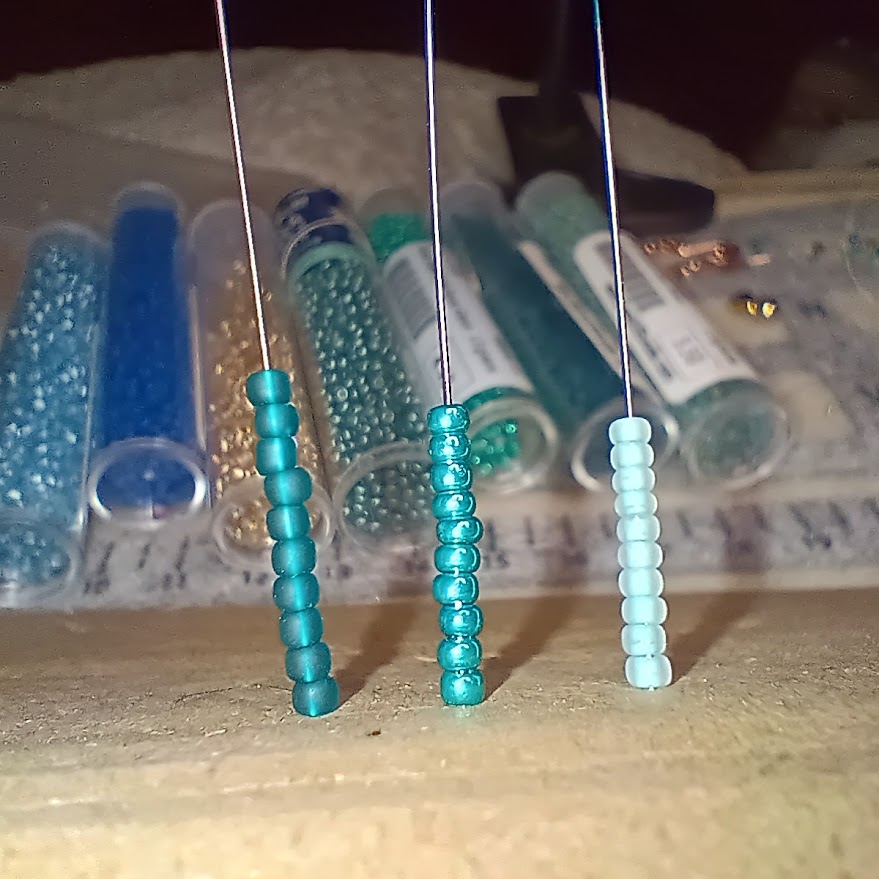
Size numbers only tell part of the story
When a bead is labeled 8/0 or 11/0, that number refers to an approximate size category. It does not describe wall thickness, hole shape, surface treatment, or overall profile. Those details matter far more than most people realize, because they directly affect how beads stack, flex, and pull against each other once thread is involved.
Two beads can share the same size number and still sit very differently in a finished piece.
Manufacturer matters more than most people think
Manufacturer plays a role here as well. Each bead company uses its own molds, glass formulas, and finishing processes. Even when beads come from the same brand and share the same size number, differences in how they are produced can affect thickness, hole shape, and overall consistency.
This is why beads that look nearly identical in the tube can behave very differently once they’re stitched. Size labels give a shared reference point, but they are not a guarantee of identical structure.
In the image below, both bead types are the same size and from the same manufacturer, yet their shape and structure behave very differently once stitched.
Finish changes more than appearance
Finish is another major factor. Matte beads are etched to remove shine, which roughens the surface and often makes the bead feel slightly thicker than a glossy bead of the same size. Plated, coated, or lined beads add layers to the glass, subtly changing height, spacing, or how beads press against one another.
These differences are small enough to go unnoticed in the tube. Once stitched, especially in structured stitches like peyote or brick stitch, they become much more apparent.
Shape variation is normal, especially with seed beads
Traditional seed beads are rounded, and that roundness allows for natural variation. Even beads from the same tube will not be perfectly identical. That variation gives seed bead work its softer, more organic feel, but it also means that mixing finishes or bead types can introduce uneven tension.
This isn’t a flaw. It’s simply how the beads are made.
Why projects sometimes stop behaving the way you expect
When bead-work begins to curve or ripple, it’s easy to assume the tension is off. Often, though, the issue isn’t technique at all. A few beads in the mix may be slightly thicker, taller, or shaped differently than the rest, and those small differences add up over multiple rows. If you are making a triangle for the top on an earring and all your beads aren’t the same size, then you will end up with a wonky triangle.
Once you understand this, troubleshooting becomes much easier. You can separate beads by finish, be more selective within a pattern, or choose stitches that are more forgiving of variation.
This is something you learn by experience
Most beaders don’t learn this from a chart or a tutorial. They learn it by doing. At some point, it clicks, and after that you start noticing bead behavior as much as bead size.
Bead size numbers are a starting point, not a guarantee. Understanding how manufacturer, finish, and shape affect bead behavior makes everything else feel far less mysterious.